
A carefully worded consensus on the conflict in West Asia emerged as one of the most closely watched outcomes of the BRICS summit in New Delhi. Iran and the United Arab Emirates, members of the expanded grouping with sharply divergent positions on the war, ultimately signed on to a joint declaration that called for maximum restraint without naming the principal parties. The agreement did not happen by chance. It was the product of a narrow diplomatic window, sustained high-level engagement, nearly 100 hours of intensive negotiations led by Indian diplomats, and timely interventions by other major members.
A Conflict That Tested BRICS Cohesion
The war in West Asia, which began in late February 2026, had already lasted six months by the time leaders gathered in New Delhi. Strikes and counter-strikes involving the United States, Iran and regional actors had raised tensions across the Gulf. The United Arab Emirates, which had faced impacts from the conflict, and Iran held opposing narratives about responsibility and legitimate response. Earlier BRICS ministerial meetings during the year had failed to produce agreed language on the issue, underscoring how difficult consensus would be.
For India, holding the BRICS chair, the stakes were clear. The absence of a joint declaration risked being portrayed as a failure of the grouping at a moment when it sought to demonstrate relevance on global questions. Finding language that both Tehran and Abu Dhabi could accept therefore became a central diplomatic task.
The Ceasefire Window and Early Outreach
A 60-day ceasefire between the United States and Iran, which remained in effect until it lapsed in August, created a limited but important opening. During this period, Indian officials intensified outreach to both sides. The aim was to keep channels open and explore whether a formulation acceptable to the broader BRICS membership could be developed.
High-level contacts reinforced the effort. Prime Minister Narendra Modi discussed related issues with UAE leadership during his visit in May. In June, he spoke with Iranian President Masoud Pezeshkian, when the question of consensus within BRICS also featured. These conversations helped establish that both capitals remained open, at least in principle, to a collective statement that avoided forcing either side to abandon its core position.
Nearly 100 Hours of Negotiations
As the summit approached, Indian diplomats with experience across Geneva, Washington, Beijing and trade negotiations invested extensive time in bridging the gap. Officials described nearly 100 hours of down-to-the-wire discussions. The central difficulty was language. Iran sought strong condemnation of attacks it attributed to the United States and Israel. The UAE wanted recognition of strikes that had affected its territory and sovereignty. Direct naming of either the United States or Iran proved unacceptable to the other side and risked collapsing the entire declaration.
The eventual solution rested on carefully calibrated phrasing. The agreed text expressed deep concern over the continued escalation of tensions in the Middle East and West Asia. It recalled the respective national positions of members and called for maximum restraint and the avoidance of actions that could further aggravate the situation. It emphasised protection of civilians and civilian infrastructure, respect for sovereignty and territorial integrity, the importance of dialogue and diplomacy, and the need to safeguard global trade, supply chains, energy flows and maritime security. References to deliberate attacks on civilian and certain nuclear facilities under international safeguards addressed Iranian sensitivities without explicit attribution, while the stress on sovereignty spoke to Emirati concerns.
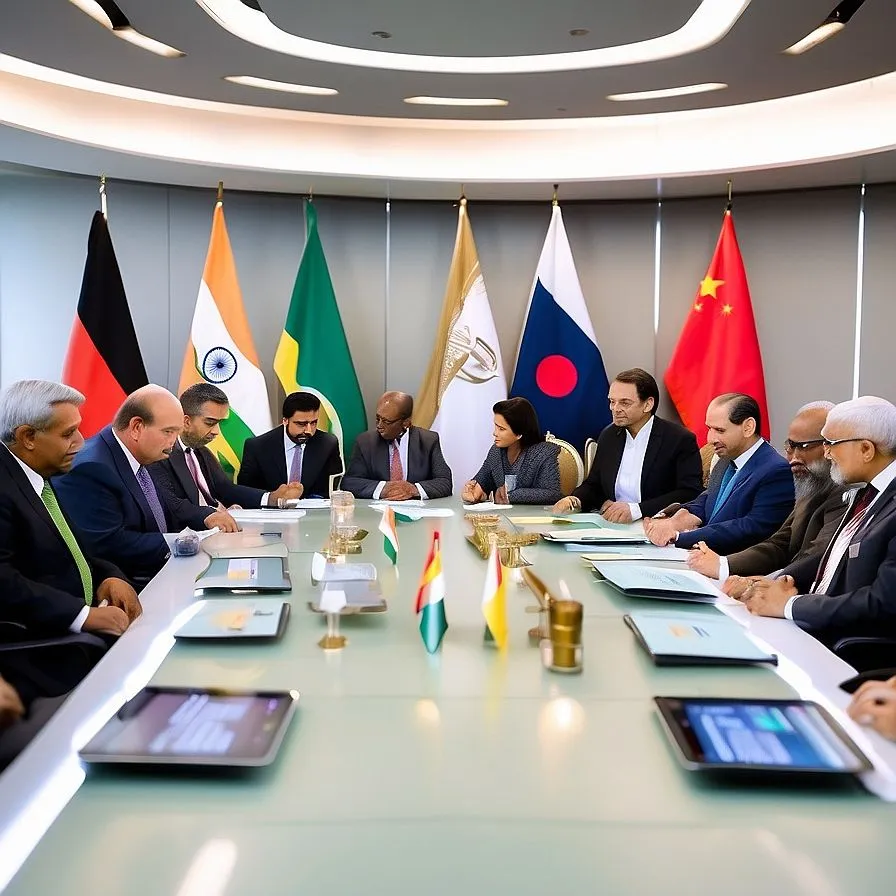
High-Level Meetings and External Nudges
The final stretch involved engagement at the highest levels. On the margins of the summit itself, Iranian President Masoud Pezeshkian met Abu Dhabi Crown Prince Sheikh Khaled bin Mohamed bin Zayed Al Nahyan—the highest-level bilateral encounter between the two sides since the conflict began. The meeting signalled a willingness to engage even amid ongoing hostilities.
China and Russia played important supporting roles in the closing phase. Diplomats indicated that once Iran had moved toward acceptance of the draft language, Beijing and Moscow helped persuade the UAE to sign off. Brazil and Egypt also provided constructive support in encouraging both parties toward compromise. The shared interest in avoiding a failed summit—particularly one that Western capitals might highlight as evidence of BRICS disunity—created additional incentive for flexibility.
Why the Consensus Mattered
The New Delhi Declaration’s paragraph on West Asia did not resolve the underlying conflict, nor did it satisfy maximalist demands from either side. Its significance lay elsewhere. It demonstrated that an expanded BRICS, now including countries with direct stakes in regional disputes, could still produce collective language on a highly sensitive issue. It preserved the practice of consensus that members regard as essential to the grouping’s character. And it showed that patient, multi-level diplomacy—combining bilateral outreach, intensive drafting work and timely great-power reinforcement—could still yield results.
For India, the outcome reinforced the value of its bridging role. Having navigated similar complexities during its G20 presidency, New Delhi again showed an ability to keep divergent members inside a common textual framework. The declaration’s broader content, covering economic cooperation, institutional reform and Global South priorities, could proceed once the West Asia paragraph was settled.
Lessons From the Process
Several factors proved decisive. The temporary ceasefire created political space that might not have existed amid active escalation. Sustained high-level attention kept the issue from being relegated to purely technical channels. Indian negotiators invested the time required to test multiple formulations. And the involvement of China and Russia at the critical moment helped close remaining gaps.
The episode also illustrated the limits of what consensus can achieve. By design, the language was general enough to accommodate opposing national positions. It neither assigned blame nor prescribed a detailed pathway to peace. In that sense, it reflected the realities of a diverse coalition more than a unified strategic stance.
Nevertheless, in a polarised international environment, the ability of Iran and the UAE to endorse a shared text under the BRICS banner was noteworthy. It required compromise, persistence and a recognition that the alternative—no declaration at all—carried its own costs. The nearly 100 hours of talks, the leader-level contacts, and the final nudges from Beijing and Moscow together turned a potential point of fracture into a managed, if limited, consensus.
Read more – huggymonster.com