
In an increasingly digital world, protecting sensitive information has become paramount. Traditional passwords and PINs, while familiar, often prove vulnerable to breaches, phishing, and human error. Biometric security offers a sophisticated alternative by leveraging unique physical or behavioral characteristics to verify identity. From fingerprint scans to facial recognition, these technologies provide robust layers of protection for personal and organizational data.
Biometrics enhance security by tying access directly to inherent traits that are difficult to replicate or steal. This article explores how biometric systems work, their advantages in safeguarding data, common methods, and important considerations for implementation.
Understanding Biometric Authentication
Biometric authentication verifies identity using distinctive biological or behavioral traits. Unlike knowledge-based methods (passwords) or possession-based ones (tokens), biometrics rely on “who you are.” Common physiological characteristics include fingerprints, facial features, iris patterns, and voice. Behavioral traits encompass typing rhythms or gait analysis.
The process typically involves enrollment, where a sample is captured and converted into a digital template stored securely, and verification, where live input is compared against the template. Matching algorithms assess similarity, granting access upon sufficient alignment.
Advanced systems employ liveness detection to prevent spoofing with photos, masks, or recordings, ensuring the presented trait belongs to a live person.
Key Biometric Methods and Their Applications
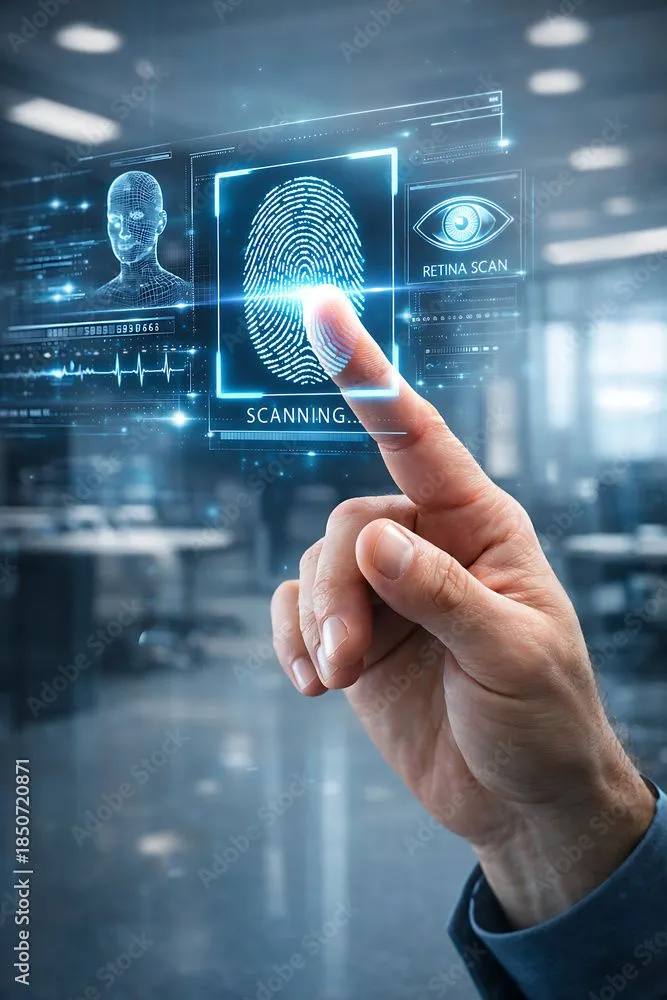
Fingerprint Recognition: One of the most established techniques, fingerprint scanners analyze ridge patterns and minutiae points. Widely used in smartphones and access control, it offers speed and high accuracy for everyday security.
Facial Recognition: Cameras map facial geometry, including distances between eyes, nose, and jaw. Deployed in device unlocking and border control, modern systems handle variations in lighting, angles, and expressions effectively.
Iris and Retina Scanning: Iris patterns provide exceptional uniqueness, captured via near-infrared light. Retina scans focus on blood vessel patterns. These methods excel in high-security environments like airports due to low false acceptance rates.
Voice Biometrics: Analyzing pitch, tone, and speech patterns, voice recognition suits phone-based authentication. It combines convenience with behavioral elements for added security.
Emerging Options: Vein patterns in palms or fingers, and even gait analysis, expand possibilities for contactless verification.
How Biometrics Protect Data
Biometric systems strengthen data protection through several mechanisms. First, uniqueness reduces impersonation risks—traits like fingerprints cannot be easily shared or guessed. Second, templates (mathematical representations) rather than raw images are stored, minimizing exposure even in breaches. Third, multi-factor integration (biometrics plus PIN) creates layered defenses.
In practice, biometrics secure mobile banking, healthcare records, corporate networks, and government databases. They streamline user experiences—eliminating password fatigue—while maintaining stringent controls, reducing unauthorized access incidents significantly.
For organizations, centralized biometric management with encryption and regular audits ensures compliance with privacy regulations while mitigating insider threats.
Advantages Over Traditional Methods
Biometric security surpasses passwords in convenience and strength. Users no longer memorize complex combinations or risk reuse across accounts. The non-transferable nature of traits prevents sharing, a common password weakness.
Scalability benefits large systems, as templates require less storage than credential databases. Speed of verification enhances user satisfaction in high-volume scenarios like airports or workplaces.
Cost savings emerge long-term through reduced password reset requests and lower fraud losses. Enhanced accountability—actions tied to verified identities—supports auditing and compliance.
Challenges and Security Considerations
Despite strengths, biometrics present challenges. Privacy concerns arise from the sensitive nature of stored data; breaches could have permanent consequences since traits cannot be changed like passwords. Robust encryption, anonymization, and decentralized storage mitigate risks.
False positives or negatives occur due to injuries, aging, or environmental factors. Quality sensors and adaptive algorithms improve reliability. Spoofing attempts, though sophisticated, are countered by liveness detection and continuous monitoring.
Legal and ethical frameworks must address consent, data minimization, and transparency. Users should understand collection purposes and retention policies.
Best Practices for Implementation
Organizations implementing biometrics should prioritize user education and choice—offering alternatives where possible. Regular testing against evolving threats ensures resilience.
Individuals can enhance personal security by enabling biometrics on devices, combining with strong secondary factors, and monitoring accounts for anomalies.
Future advancements like behavioral biometrics and AI-driven analysis promise even greater accuracy and adaptability.
Conclusion
Biometric security represents a significant advancement in data protection, offering unparalleled convenience and strength through unique personal traits. By understanding methods, advantages, and responsible implementation, individuals and organizations can harness these technologies effectively while addressing privacy considerations.
As digital interactions expand, biometrics will play an increasingly vital role in safeguarding information. Embracing them thoughtfully balances security needs with ethical responsibilities, fostering trust in an interconnected world.