
In today’s interconnected digital world, applications rarely operate in isolation. They constantly exchange data and services with other systems, powering everything from social media feeds to online payments. At the heart of this seamless interaction lies the API, or Application Programming Interface. For beginners, APIs might sound technical, but they function as straightforward bridges enabling software to communicate efficiently.
This guide breaks down APIs in simple terms, covering their purpose, mechanics, types, and practical value. By the end, you’ll understand how they power modern apps and why they matter for developers and users alike.
What Is an API?
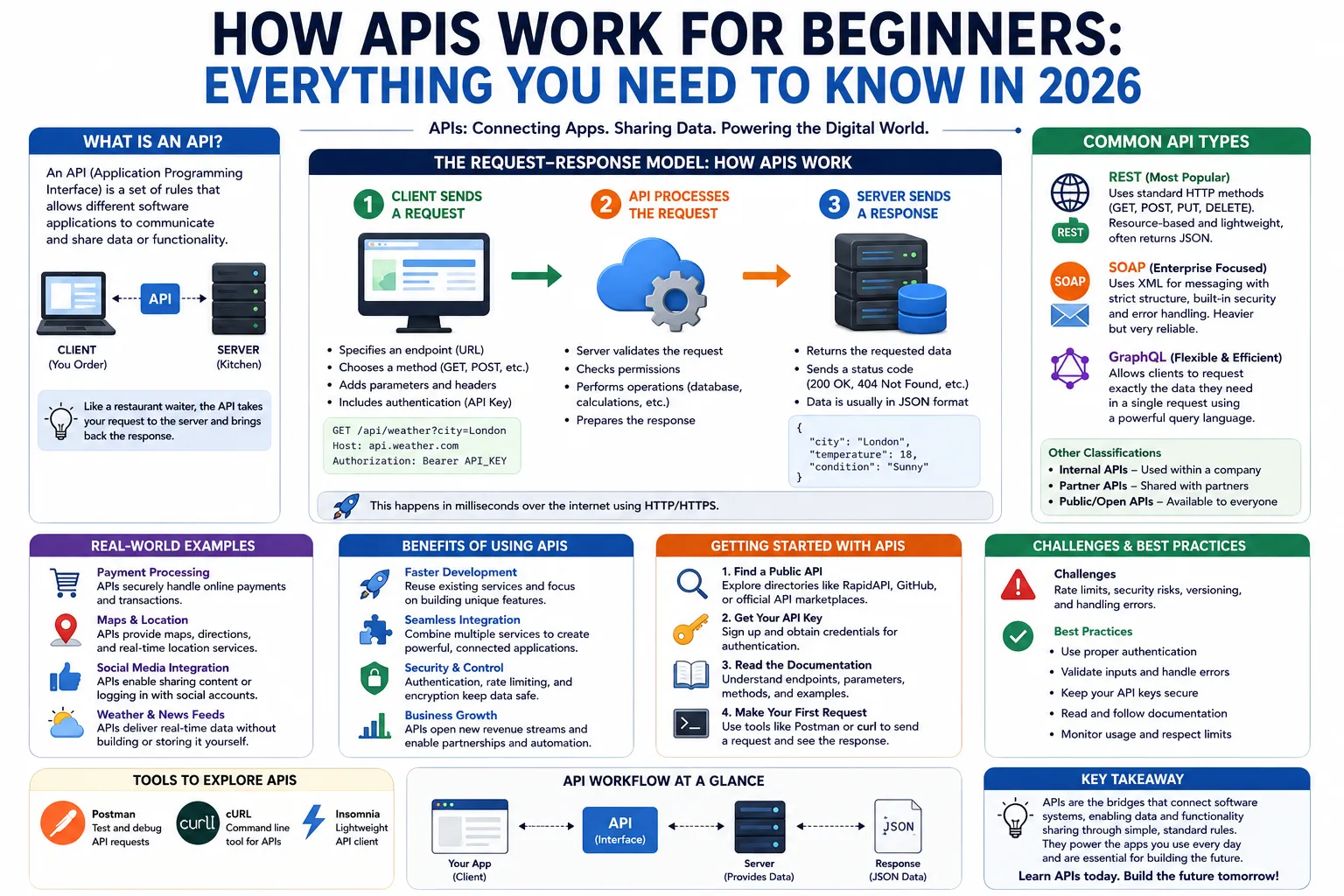
An API is a set of rules, protocols, and tools that allows different software applications to communicate and share data or functionality. Think of it as a menu in a restaurant: the kitchen (server) prepares the food (data or actions), while the waiter (API) delivers your order (request) and brings back the meal (response) without you needing to enter the kitchen.
APIs define how requests are made, what data formats are used, and how responses are structured. They hide complex internal workings, letting developers focus on building features rather than reinventing core systems. For instance, when a weather app displays current conditions, it likely pulls data from a specialized weather service via an API rather than maintaining its own sensors.
The Request-Response Model: How APIs Work Step by Step
APIs typically operate on a request-response cycle:
- The Client Sends a Request: An application (client) constructs a message specifying what it needs. This includes an endpoint (a specific URL or address), a method indicating the action (e.g., retrieve or update data), parameters for details, and often authentication credentials.
- The API Processes the Request: The server receives the request, verifies permissions, performs necessary operations (querying databases, running computations), and prepares a response.
- The Server Sends a Response: This usually includes the requested data, often in JSON format for easy parsing, along with a status code indicating success (e.g., 200 OK) or errors (e.g., 404 Not Found).
This cycle happens rapidly over networks, often using HTTP as the underlying protocol. Most interactions are stateless, meaning each request contains all necessary information without relying on previous ones, promoting scalability.
Common API Types and Architectures
Several API styles exist, each suited to different needs:
- REST (Representational State Transfer): The most popular for web services. REST uses standard HTTP methods like GET (retrieve), POST (create), PUT (update), and DELETE. It is resource-based, flexible, and leverages existing web infrastructure. Responses are often lightweight in JSON.
- SOAP (Simple Object Access Protocol): An older, more structured protocol using XML for messages. It includes built-in security and error handling, making it common in enterprise systems requiring strict contracts and reliability. However, it can be heavier due to XML overhead.
- GraphQL: A query language allowing clients to request exactly the data needed in one call, reducing over-fetching or multiple requests. It uses a single endpoint and a schema to define available data, offering efficiency for complex or mobile applications.
Other types include internal (private to a company), partner (shared with specific collaborators), and open/public APIs (available to developers broadly).
Real-World Examples of APIs in Action
APIs power countless everyday experiences:
- Payment Processing: Services handle transactions securely via API calls from e-commerce sites.
- Mapping and Location: Tools let apps embed maps, provide directions, or geolocate users.
- Social Media Integration: Platforms allow sharing content or logging in with existing accounts.
- Weather or News Feeds: Apps fetch real-time data without building their own collection systems.
In development, APIs enable microservices architectures where independent components communicate, improving maintainability and scalability.
Benefits of Using APIs
APIs accelerate innovation by promoting reusability—developers leverage existing services instead of building from scratch. They foster integration, allowing apps to combine strengths (e.g., a fitness tracker pulling music playlists). Security features like authentication and rate limiting protect data, while standardization ensures consistency.
For businesses, APIs create new revenue streams through partnerships or monetized access. They also support automation and data-driven decisions across systems.
Getting Started with APIs as a Beginner
To explore APIs:
- Find a Public API: Many free options exist for practice, such as those for jokes, quotes, or public data.
- Obtain Credentials: Most require an API key for tracking and access control.
- Read Documentation: This outlines endpoints, parameters, authentication, and examples.
- Make Requests: Tools simplify testing. Start with GET requests to retrieve data.
Practice handling responses, errors, and authentication. Focus on understanding HTTP status codes and data formats like JSON.
Challenges and Best Practices
Common hurdles include rate limits, versioning (to avoid breaking changes), and security risks like unauthorized access. Best practices involve proper authentication, input validation, comprehensive documentation, and monitoring usage. Always handle errors gracefully in client code and respect terms of service.
As technology evolves, trends like GraphQL adoption and AI-powered APIs continue shaping the landscape, but core principles of clear contracts and reliable communication remain constant.
Conclusion
APIs are the invisible glue connecting the modern digital ecosystem, enabling applications to share data and functionality efficiently through structured request-response interactions. From REST’s flexibility to GraphQL’s precision and SOAP’s robustness, understanding these tools opens doors to building powerful, integrated software.
For beginners, starting with simple public APIs and experimenting hands-on demystifies the process. As you progress, you’ll appreciate how APIs drive innovation, save development time, and create richer user experiences. Embrace them as essential building blocks—whether consuming services or designing your own—and you’ll be well-equipped for software development in 2026 and beyond.