
Deadly floods that swept through Nepal and neighbouring areas of China have left more than a thousand people dead and thousands missing, while destroying communities, roads, bridges and critical hydropower infrastructure. The disaster has renewed difficult questions about whether some Himalayan settlements and projects can continue to be rebuilt in the face of rising climate-linked risks.
The Scale of the Disaster
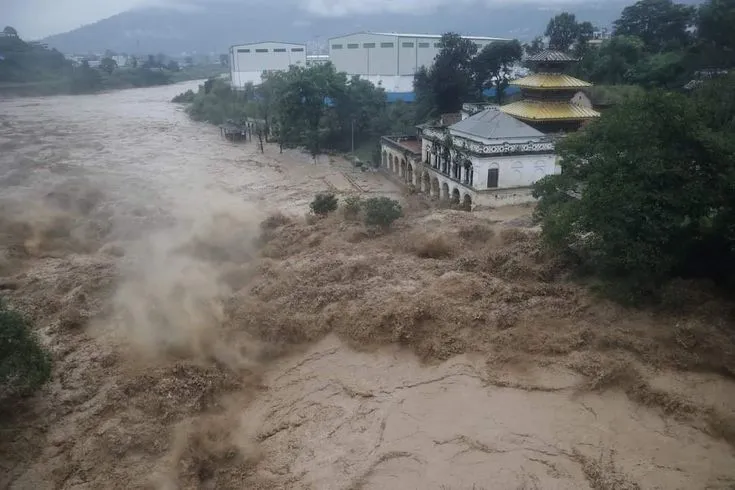
In late August, a massive collapse of bedrock and glacial ice high in the mountains sent a wall of water, mud and debris racing through valleys along the Nepal-China border. The surge travelled many kilometres downstream, overwhelming settlements and infrastructure with little warning. Confirmed deaths have surpassed 1,000 across both countries, with several thousand people still unaccounted for. Hundreds of workers at hydropower sites remain among the missing, and rescue operations have continued in remote and debris-choked areas.
The floods damaged or destroyed multiple hydropower plants and projects under construction. Roughly 10 percent of Nepal’s electricity generation capacity was knocked offline, forcing the country to halt power exports and turn to imports to meet domestic needs. Roads, bridges and a key border crossing were washed away, disrupting trade and isolating communities. Initial assessments point to reconstruction costs running into billions of dollars for the worst-affected districts.
Climate Change and Cascading Mountain Hazards
Scientists and officials have linked the disaster to conditions shaped by a warming climate. Glaciers across the Hindu Kush Himalaya are losing ice at an accelerating rate. Permafrost is thawing, slopes are becoming less stable, and rainfall patterns are growing more erratic. These changes increase the likelihood of complex, cascading events in which ice and rock collapses trigger flash floods that travel far downstream.
Experts note that historical records of river behaviour and flood frequency are becoming less reliable guides for planning. What once appeared as rare extremes is occurring more often. Satellite imagery and seismic data from the recent event illustrate how a high-altitude collapse can generate destructive flows capable of reshaping valleys and overwhelming infrastructure designed under older assumptions.
Climate policy specialists in Nepal have observed that adaptation thresholds may already have been crossed in certain locations. In such places, the combination of glacial instability, steep terrain and human settlement makes continued habitation or reconstruction increasingly hazardous.
Hydropower Ambitions Under Pressure
Nepal has invested heavily in hydropower as a cornerstone of its energy strategy and a source of export revenue. The recent floods exposed the vulnerability of plants sited in river valleys that are now subject to heightened geological and climatic risks. Several operating stations and projects under construction suffered severe damage, and large numbers of workers were caught in the path of the surge.
The temporary loss of generation capacity has immediate economic consequences. Beyond the direct repair costs, the episode raises longer-term questions for investors and planners. Projects designed around past hydrological patterns may face higher risks of damage or shortened lifespans as mountain conditions continue to change. Experts argue that future assessments must incorporate evolving climate projections, slope stability and the potential for cascading hazards rather than relying primarily on historical data.
The Dilemma of Rebuilding
For communities that lost homes, livelihoods and infrastructure, the instinct is to rebuild. Yet the repeated nature of flash floods, landslides and related disasters is forcing a harder conversation. In some high-risk zones, the cost and danger of reconstruction may outweigh the benefits of remaining in place. Relocation, while emotionally and economically difficult, is increasingly discussed as a possible response where danger levels have become extreme.
Roads, bridges and power facilities are essential for connectivity and development. At the same time, placing them in the most exposed corridors multiplies the potential for loss when the next extreme event occurs. Climate specialists stress that development plans for the Himalayas need to weigh these trade-offs more carefully, incorporating stronger early-warning systems, revised design standards and, in some cases, decisions to avoid the highest-risk locations altogether.
Nepal’s government has highlighted the role of climate change in the disaster and called for greater international attention and support. As a country that contributes little to global emissions yet faces severe impacts, it has emphasised the need for assistance with both recovery and longer-term adaptation.
Looking Ahead
The floods of late August have made visible the growing mismatch between traditional patterns of mountain settlement and infrastructure and the new realities of a warming cryosphere. Glacial melt, unstable slopes and intense runoff events are no longer distant threats; they are present dangers that can erase years of development in hours.
Rebuilding will be necessary and urgent for many communities. The deeper challenge is to rebuild in ways that reduce rather than recreate exposure. That may require updated risk mapping, stricter location criteria for critical facilities, investment in monitoring and warning systems, and honest assessments of where continued occupation is no longer tenable.
The Himalayan region supports millions of people and supplies water and energy far beyond its slopes. The recent disaster in Nepal and adjacent Chinese territory is a stark reminder that climate-driven changes in these mountains carry consequences that cannot be ignored. How governments, communities and international partners respond to the twin tasks of recovery and risk reduction will shape the safety and viability of mountain life for decades to come.
Read more – therecipetaste.com , uuploadarticle.com