
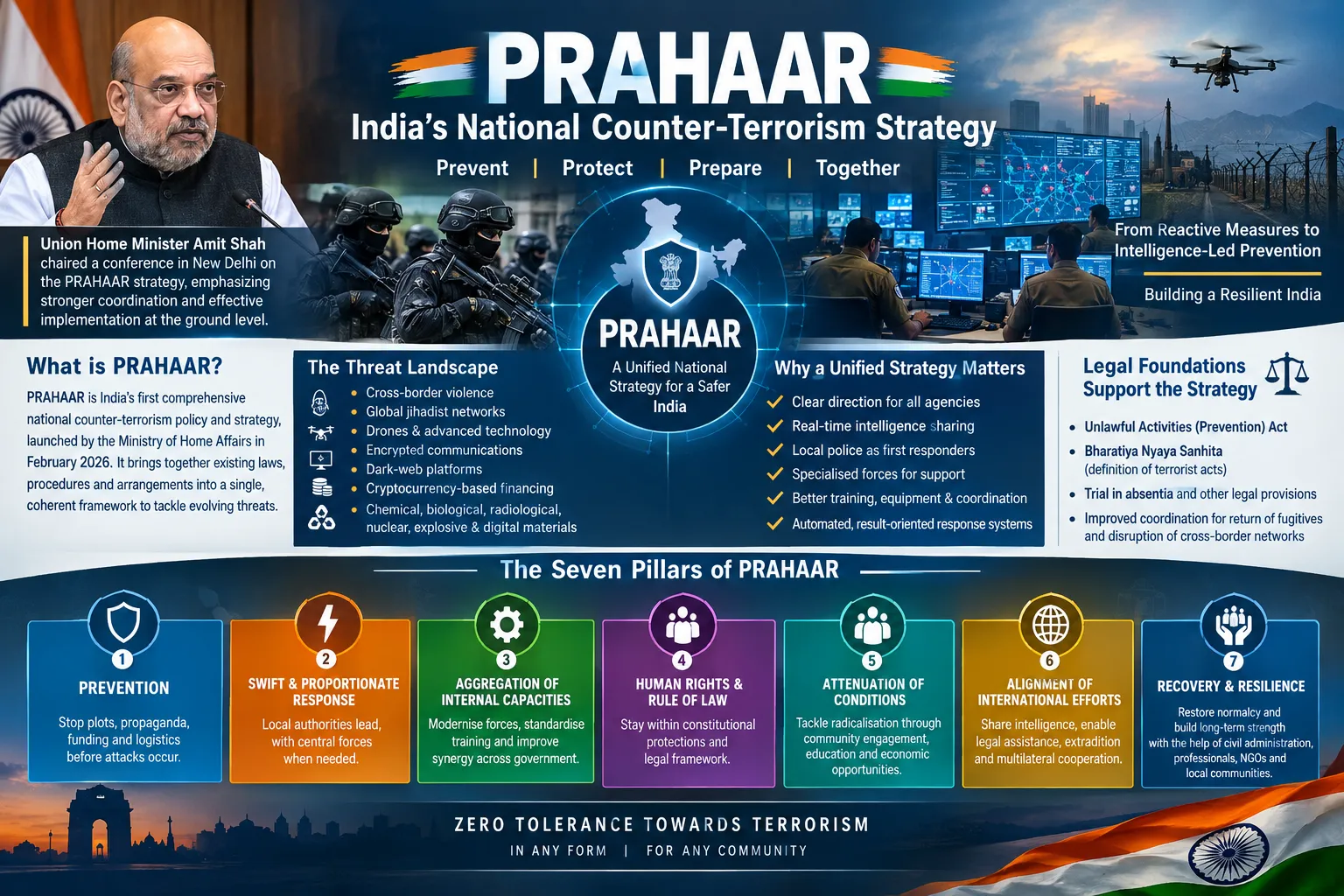
Union Home Minister Amit Shah recently chaired a conference in New Delhi on the PRAHAAR counter-terrorism strategy and stressed the need for stronger coordination and effective implementation at the ground level. The meeting focused on taking the principles of the strategy down to the police station level and building an automated, result-oriented response system that can address evolving threats over the next decade. PRAHAAR stands as India’s first comprehensive national counter-terrorism policy and strategy. It is designed to shift the country’s approach from reactive measures toward intelligence-led prevention and a whole-of-society model of resilience.
Understanding the PRAHAAR Framework
PRAHAAR was unveiled by the Ministry of Home Affairs in February 2026 as India’s first publicly articulated national counter-terrorism policy and strategy. Until its release, the country’s counter-terrorism architecture remained distributed across various laws, internal procedures, cabinet decisions and state-level arrangements. PRAHAAR brings these elements together into a single, coherent national framework. The document outlines a broad threat landscape that includes decades of cross-border violence, the presence of global jihadist networks, and the increasing use of advanced technologies such as drones, encrypted communications, dark-web platforms, cryptocurrency-based financing and potential access to chemical, biological, radiological, nuclear, explosive and digital materials.
The strategy rests on seven interconnected pillars. These are prevention of terror attacks, swift and proportionate response, aggregation of internal capacities, adherence to human rights and the rule of law, attenuation of conditions that enable terrorism, alignment of international efforts, and recovery and resilience through a whole-of-society approach. Together they form the acronym that gives the policy its name. The framework explicitly adopts a doctrine of zero tolerance toward terrorism in all its forms while affirming that terrorism is not associated with any particular religion or community.
Why a Unified National Strategy Matters
The absence of a single public national policy had long meant that counter-terrorism efforts, though substantial, lacked a unifying doctrinal statement. Specialised agencies, intelligence-sharing platforms and legal instruments existed, yet their coordination depended heavily on established practice rather than a clearly articulated national strategy. PRAHAAR seeks to change that by providing clarity of purpose across central and state agencies. It emphasises real-time intelligence sharing, positions local police as the first line of response with specialised forces available for support, and calls for systematic attention to gaps in training, equipment and inter-agency coordination.
A central message from the recent conference was the need to institutionalise the strategy for the next ten years. Continuous analysis of terror incidents, the creation of automated response mechanisms at every level, and the percolation of PRAHAAR’s principles down to the thana level were identified as essential steps. The presence of senior officials from the Home Ministry, external affairs, central armed police forces, state police leadership and anti-terrorist squads underlined the multi-agency character of the effort.
The Seven Pillars and Their Operational Meaning
Prevention forms the first and most important pillar. It prioritises intelligence gathering and the proactive disruption of plots, propaganda networks, funding channels and logistical support before attacks can occur. The response pillar focuses on swift, coordinated and proportionate action. Local authorities are expected to lead, with specialised central forces providing reinforcement when the situation demands it.
Aggregating internal capacities involves modernising police forces, standardising training protocols and improving synergy across the whole of government. The human rights pillar makes clear that counter-terrorism measures must remain consistent with constitutional protections and the rule of law. This inclusion elevates an element that had often remained implicit in earlier operational approaches.
Attenuating the conditions that enable terrorism addresses the social and ideological roots of radicalisation. It calls for community engagement, educational and economic opportunities, and targeted outreach, particularly among youth and vulnerable groups. Aligning international efforts covers intelligence sharing, mutual legal assistance, extradition processes and participation in multilateral counter-terrorism mechanisms. The final pillar, recovery and resilience, emphasises the role of civil administration, professionals, non-governmental organisations and local communities in restoring normalcy and building long-term societal strength after any incident.
Legal Foundations Supporting the Strategy
PRAHAAR does not replace existing laws. It provides a policy umbrella under which legal instruments are expected to function in a more integrated manner. The Unlawful Activities (Prevention) Act remains the principal special law for dealing with terrorist acts and organisations. The Bharatiya Nyaya Sanhita incorporates a clear definition of terrorist acts, strengthening the statutory basis for investigation and prosecution. Provisions such as trial in absentia form part of the broader legal architecture that supports the operational goals of the strategy. The recent conference also highlighted the practical value of improved coordination, including the return of fugitives from abroad and the disruption of cross-border networks involved in the smuggling of weapons, explosives and narcotics.
Challenges of Implementation
Translating a national framework into consistent practice across a federal system presents significant challenges. Differences in capacity, resources and threat perceptions among states require sustained attention and support. The rapid evolution of technologies used by terrorist networks demands continuous adaptation of both intelligence methods and legal tools. Maintaining public trust while pursuing the aggressive disruption of threats requires careful adherence to the human rights and rule-of-law commitments that the strategy itself places at its centre.
The success of PRAHAAR will ultimately be measured by its ability to reduce the operational space available for terrorist activity, improve the speed and quality of inter-agency response, and strengthen societal resilience. By placing prevention, coordination and long-term capacity at the centre of national policy, the framework seeks to move India from a primarily incident-driven posture toward a more systematic and anticipatory counter-terrorism architecture.
Looking Ahead
The recent conference served as an important reminder that policy documents alone are insufficient. Sustained political attention, institutional discipline and genuine ownership at the ground level will determine whether PRAHAAR delivers lasting results. The directive to take the strategy to the police station level, the call for automated response mechanisms, and the emphasis on a ten-year institutional horizon all point toward an effort to embed the framework deeply within the daily functioning of the security system. As threats continue to evolve, the ability of PRAHAAR to adapt while remaining faithful to its core principles will shape the effectiveness of India’s national counter-terrorism effort in the years ahead.
Read more – Sizematchr.com