
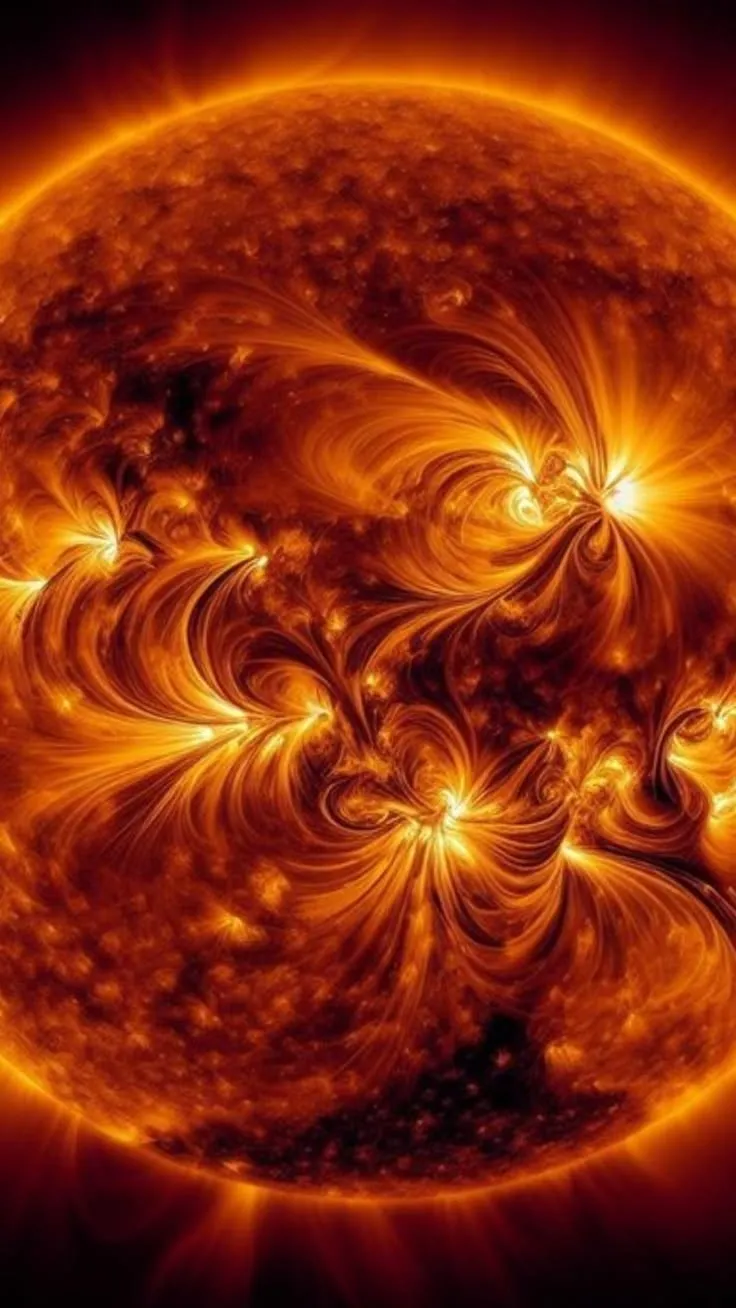
Scientists have captured the highest-resolution images ever recorded of the Sun’s visible surface, revealing swirling, vortex-like patterns that closely resemble the turbulent sky in Vincent van Gogh’s The Starry Night. The observations, made with the world’s most powerful solar telescope, show small-scale wave structures known as Kelvin-Helmholtz instabilities for the first time on the Sun. Researchers say these patterns play a key role in how magnetic energy moves, builds up and eventually erupts into powerful solar storms.
A New Level of Detail
The images come from the National Science Foundation’s Daniel K. Inouye Solar Telescope, located on Haleakalā in Hawaii. The telescope is designed to study the Sun in unprecedented detail. In recent observations, it resolved features on the solar surface at scales of only tens of kilometres—remarkable given that the Sun is roughly 150 million kilometres from Earth.
What the images show is the photosphere, the Sun’s visible “surface,” in sharper focus than ever before. Across this layer, hot plasma rises and falls in cell-like structures called granules. At the edges of some of these granules, especially near sunspots and smaller magnetic pores, the new data reveal rolling, wave-shaped vortices. These had been theoretically predicted but never directly observed until now.
The Van Gogh Connection
Scientists involved in the work have noted the visual similarity between the newly imaged solar vortices and the swirling forms in van Gogh’s famous painting. The comparison is more than poetic. Kelvin-Helmholtz instabilities appear whenever two fluids or plasmas of different speeds flow past each other, creating billowing waves and spiral structures. The same basic physics produces certain cloud patterns on Earth, wave formations in oceans, and features in the atmospheres of other planets. On the Sun, the “fluids” are streams of superheated plasma moving within strong magnetic fields.
The result is a dynamic, almost artistic texture of twisting motions across parts of the solar surface. Because the structures are so small and short-lived, earlier telescopes lacked the resolution and stability to capture them clearly.
Why These Patterns Matter
The Sun’s magnetic field drives nearly all of its most energetic behaviour. Magnetic energy can accumulate in twisted and stressed field lines until it is suddenly released in solar flares or coronal mass ejections. These events launch radiation and charged particles into space and can disrupt satellites, power grids, communications and navigation systems on Earth. Understanding the early stages of energy build-up is therefore essential for improving space-weather forecasts.
The newly observed Kelvin-Helmholtz vortices appear to twist and stretch magnetic fields at small scales. This twisting injects energy into the magnetic system. Over time, that energy can cascade upward into larger structures and contribute to the conditions that produce major eruptions. By revealing the process in action, the images give researchers a direct look at one of the mechanisms that feeds solar storms.
Scientists also note that these small-scale motions may help explain long-standing puzzles, such as why the Sun’s outer atmosphere, the corona, is hundreds of times hotter than the surface below it. Energy transferred through wave and vortex activity is one of the candidate processes that could carry heat outward.
From Theory to Observation
Kelvin-Helmholtz instability is a well-established concept in fluid dynamics. Solar physicists had long suspected it operated on the Sun, but confirming it required both extreme spatial resolution and the ability to track rapid changes. The Inouye Solar Telescope provided both. When researchers compared the observations with advanced computer simulations of solar plasma and magnetic fields, the match confirmed that the swirling patterns were indeed Kelvin-Helmholtz vortices.
The structures form preferentially where strong magnetic fields and plasma flows interact—near sunspots and pores. There, the contrast in flow speeds is sufficient to trigger the instability. Once formed, the vortices evolve quickly, making continuous high-resolution monitoring essential.
Implications for Space Weather
Space-weather prediction currently relies on monitoring large-scale active regions, sunspot complexity and coronal conditions. Adding knowledge of the small-scale processes that inject and transport magnetic energy could refine those models. If scientists can better quantify how much energy these vortices contribute and how efficiently it moves into the solar atmosphere, forecasts of when and how strongly the Sun might erupt could improve.
The practical stakes are significant. Modern society depends on technologies sensitive to solar disturbances. Even moderate storms can affect high-frequency radio, GPS accuracy and satellite operations. Severe events carry greater risks. Any advance that links the tiniest surface motions to large-scale eruptions strengthens the foundation for earlier and more accurate warnings.
A Window into Stellar Physics
Beyond immediate applications, the observations enrich fundamental understanding of how stars work. The Sun is the only star whose surface can be studied in such fine detail. Processes seen here—convection, magnetic concentration, wave generation and instability—operate on other stars as well, often at scales that will remain unresolved for the foreseeable future. High-resolution solar data therefore serve as a laboratory for stellar physics more broadly.
The images also illustrate the continuing value of ground-based solar telescopes. While space missions provide uninterrupted views and access to wavelengths blocked by Earth’s atmosphere, large apertures on the ground still deliver the finest spatial resolution for visible-light studies of the photosphere.
Looking Ahead
Further observations with the Inouye Solar Telescope and complementary instruments will track how these vortices evolve under different magnetic conditions and how their energy couples to higher layers of the solar atmosphere. Combined with improved simulations, the data should clarify the pathway from small-scale twisting to large-scale eruptions.
The highest-resolution images of the Sun yet obtained have done more than set a technical record. They have made visible a process that helps power the Sun’s most disruptive behaviour. The swirling, van Gogh-like patterns are not merely striking to look at; they are a newly confirmed piece of the mechanism by which magnetic energy is generated, stored and released. In revealing them, scientists have taken a meaningful step toward understanding—and eventually forecasting—the solar storms that link the Sun’s restless surface to conditions in near-Earth space.
Read more – situsmerahtoto.info